When Should My Child First See the Dentist? A Parent's Guide
Your child should see a dentist by age one. Learn what to expect, how to prepare, and the signs every parent should watch for at Gardens Dental.
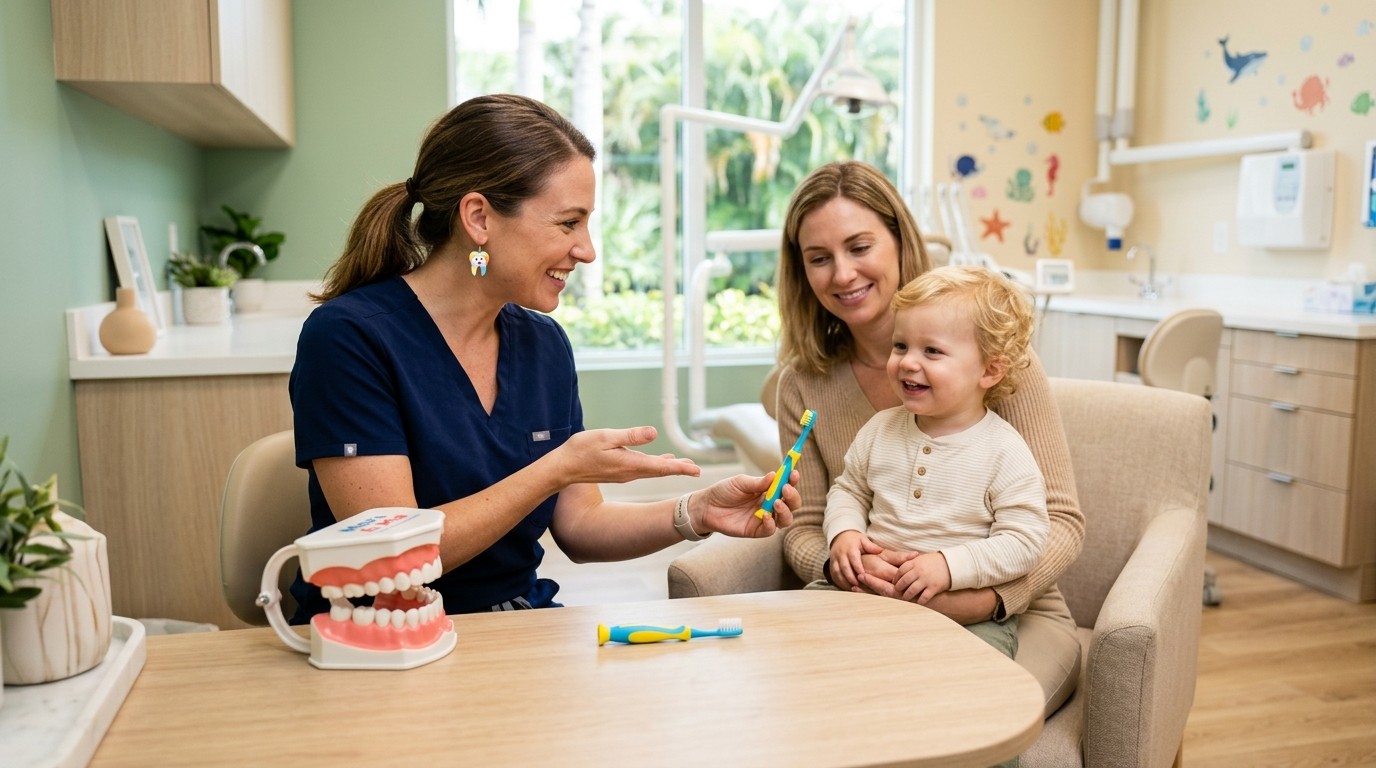
When should a child have their first dental visit?
Your child should see a dentist within six months of the first tooth erupting, and no later than age one. That is the joint recommendation from the American Academy of Pediatric Dentistry, the American Dental Association, and the American Academy of Pediatrics. The "age one" rule exists because roughly 23 percent of children aged 2 to 5 already have cavities in their primary teeth, and decay can start the moment that first tooth comes in. An early visit at our family-oriented Palm Beach Gardens office establishes a "dental home" so we can catch risk factors, coach you on home care, and prevent problems before they cost your child pain or a filling.
Here is what every parent should know before that first visit
TLDR – Your child's first dental visit:
Timing: First visit by age one or within six months of the first tooth, whichever comes first.
Why so early: Children with a first visit before age one have 40 percent lower dental costs in their first five years.
What we do: Brief oral exam, risk assessment, fluoride guidance, home care demonstration on a real toddler.
How long it takes: Most age-one visits run 20 to 30 minutes, with the child on a parent's lap.
How to prep them: Use neutral words like "count your teeth," play dentist at home, skip scary trailers from older siblings.
What to avoid: Bribing with candy, promising "no needles," or transferring your own dental anxiety to the appointment.
Follow-up cadence: Every six months after the first visit, same as adults.
If you are reading this with a toddler in your lap, you are not late and you are not early. You are exactly on time. The shift from "first visit by age three" to "first visit by age one" happened because pediatric dentists realized waiting until preschool meant catching decay instead of preventing it. The AAPD's policy on Early Childhood Caries notes that ECC remains the most common chronic disease of childhood, and that establishing a dental home by age one is the single most effective prevention strategy. The visit itself is mostly conversation, gentle examination, and parent coaching. There are no drills, no needles, and usually no tears once the child realizes nothing scary happens.
For families in Palm Beach Gardens, Jupiter, and North Palm Beach, our general dentist Dr. Sujit Shakya regularly sees children for these first visits. The atmosphere is unhurried, the language is age-appropriate, and we structure the appointment around your child's pace, not a clock. If your child needs more clinical care than a first visit covers, we coordinate with you on next steps including a referral to a pediatric specialist when appropriate. The goal of this visit is not to fix anything. The goal is to build trust and equip you with the information you need to protect your child's teeth at home.

What actually happens at the age-one dental visit
The first visit is short, conversational, and almost entirely focused on you, the parent. A 2022 review in the journal Children describes the standard first-visit components: an oral examination of the erupted teeth, gum tissue, and bite; a caries risk assessment that looks at diet, fluoride exposure, and family history; a demonstration of correct brushing technique on the child; and "anticipatory guidance," which is dental shorthand for "what to expect next." For most one-year-olds, the exam is performed knee-to-knee, with the child seated on your lap facing you, then tipped back so their head rests in the dentist's lap. That position lets the dentist see clearly while the child stays connected to you. It usually lasts under two minutes.
The conversation matters more than the exam
After the exam, the bulk of the appointment is the parent conversation. We will ask about bottle and breastfeeding patterns at night, juice and sippy cup use, whether you brush with fluoride toothpaste yet, and how your own dental history played out. Each answer adjusts the recommendations. A child who falls asleep with a milk bottle has a different risk profile than a child who finishes a bottle in the high chair. We will demonstrate brushing technique on your child during the appointment so you see how a rice-grain smear of fluoride toothpaste looks on a 12-month-old, and how to position the brush against tiny molars when they arrive. If your child needs help getting comfortable in the chair on future visits, we can refer to our guide on helping anxious kids relax for what to practice at home.
How to prepare your child for the visit (and what not to do)
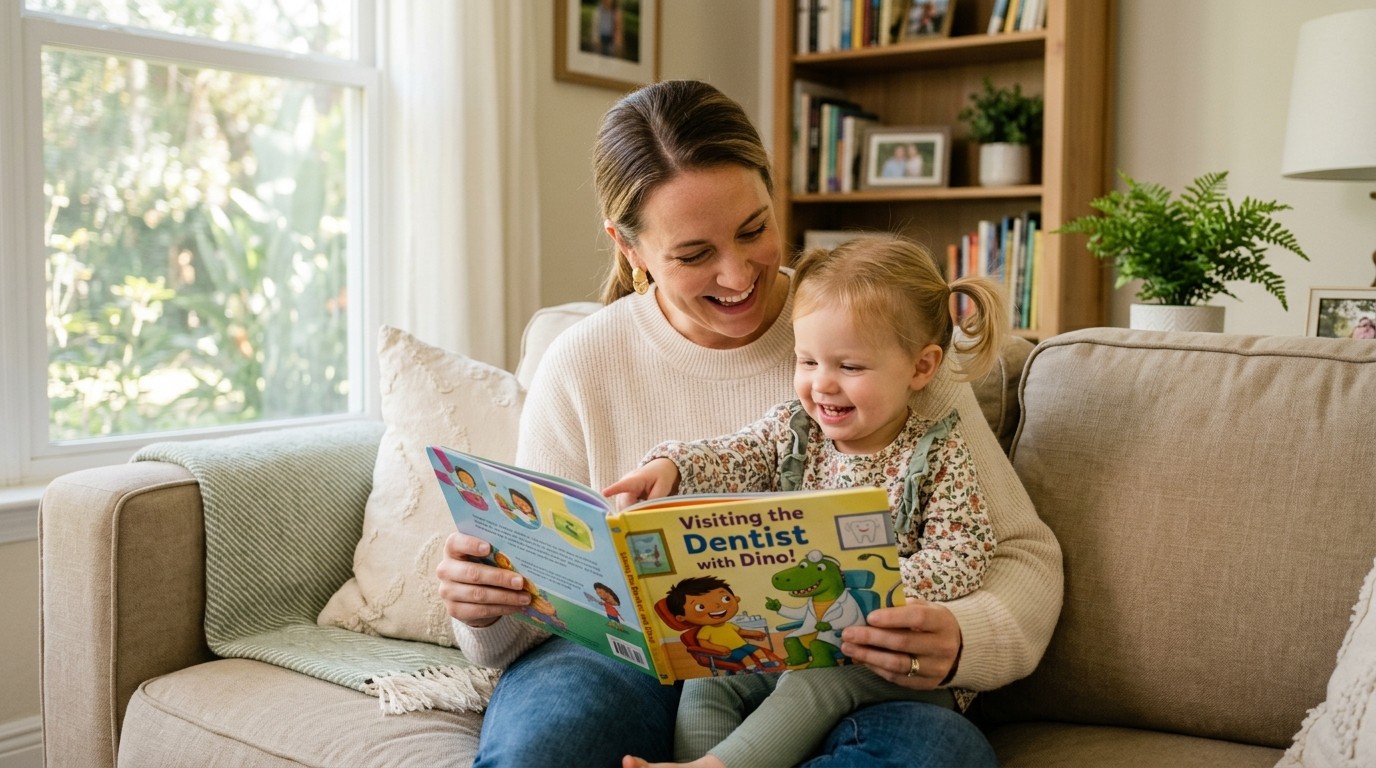
Preparation matters more than parents realize. The same review on preparing children for their first dental visit notes that "the information children receive about the dental environment before the visit can influence their behavior, both positively and negatively." Translation: how you talk about the dentist at home is more important than the dentist's office decor. The most effective preparation strategies are simple. Read a picture book about a dentist visit a week before. Play "count your teeth" with a soft-bristled brush at home so the child has felt that motion before. Watch one of the friendly toddler dentist videos on YouTube together. Show them where you are going on a map. Treat the visit as routine, like a haircut, not as an event.
The things parents accidentally do that backfire
There is a short list of well-meaning moves that make first visits harder. Do not bribe with candy or ice cream "if you behave." It tells the child something scary is about to happen and it primes the exact food behavior that creates cavities, which the CDC's 2024 Oral Health Surveillance Report identifies as the dominant driver of pediatric tooth decay. Do not use the words "shot," "drill," "hurt," "needle," or "pain" even to reassure them that none of those will happen. The brain hears the noun, not the negation. Do not let older siblings tell first-visit horror stories in the car ride over. And do not project your own dental anxiety. If you have a complicated history with dentists, send your partner if possible, or take a quiet breath in the lobby before walking back. Children read your face before they read the room. We see this play out daily, and it is the single biggest variable in how the appointment lands.

Signs to watch for between visits, and how often to come back
After the first visit, the AAPD recommends a return appointment every six months, same as adults. Between visits, watch for white spots along the gum line of front teeth, brown or black discoloration on any tooth, persistent bad breath that does not resolve with brushing, swollen or bleeding gums, refusal to chew on one side, or a tooth that looks chipped after a fall. Any of those warrant a call, not a "wait until the next checkup." Early-stage Early Childhood Caries appears as a chalky white line near the gums and is reversible at that stage with fluoride and dietary change. By the time it is brown, it usually needs a restoration. The window is short, which is why six-month visits matter even when nothing looks wrong from the outside.
For Palm Beach Gardens families, our broader coverage of pediatric dental care includes how to teach kids brushing habits that actually stick, why regular cleanings matter, and what to do in a pediatric dental emergency. Bookmark those before you need them. Most parents find the second and third visits dramatically easier than the first because the child now knows the office, the chair, and the people.
Schedule your child's first dental visit
Ready to bring your child in for their first dental visit? We serve families across Palm Beach Gardens, Jupiter, and North Palm Beach. Schedule a comprehensive consultation with Dr. Sujit Shakya at Gardens Implant & Cosmetic Dentistry. We will give your child an unhurried, gentle first experience, coach you through home care, and build a six-month plan that protects those new teeth. Call (561) 691-1629 or book your free consultation.
Blog


