Lumineers vs Veneers: Which Is Right for Your Smile?
Lumineers vs veneers: compare tooth prep, thickness, longevity, reversibility, and cost. See which suits your smile in Palm Beach Gardens, FL.

Lumineers vs Veneers: Which One Actually Fits Your Smile?
Lumineers are an ultra-thin (about 0.2 mm) brand of no-prep porcelain veneer made by DenMat, while traditional porcelain veneers are roughly 0.5 to 0.7 mm thick and usually require a small amount of enamel reduction. The decision really comes down to your starting tooth shape, color, and how much change you want. A 2021 systematic review in the Journal of Clinical Medicine reported a 10-year cumulative survival rate of 95.5% for porcelain laminate veneers when bonded to enamel, which sets a high bar both options must clear. For most patients in Palm Beach Gardens, the right answer is the one that protects healthy enamel while still delivering the color, length, and symmetry the smile actually needs.
What This Guide Covers
TLDR – Lumineers vs Veneers:
Thickness: Lumineers around 0.2 mm, traditional veneers 0.5 to 0.7 mm.
Tooth prep: Lumineers usually no prep, veneers require light enamel reduction.
Reversibility: Lumineers are often reversible, traditional veneers are not.
Durability: Both can last 10 to 15+ years when bonded to enamel and well maintained.
Best for: Lumineers favor minor color and shape changes, veneers handle bigger transformations.
Cost: Veneers in Florida typically run higher per tooth, Lumineers sit in a similar premium range.
Maintenance: Both rely on perfect margins, nightguards if you grind, and steady hygiene.
Lumineers were introduced as a no-prep, additive way to mask discoloration, close small gaps, and improve tooth shape without grinding down the underlying tooth. Traditional porcelain veneers have a longer clinical track record and remain the gold standard when teeth are crowded, worn, darkly stained, or asymmetric. The two products solve overlapping problems with different trade-offs, so the comparison is really about candidacy, not which brand is universally better. The data on no-prep veneers has actually strengthened over the last decade, which is why a careful cosmetic exam matters more than the brand on the box.
At Gardens Implant & Cosmetic Dentistry, Dr. Hans Almanzar (DDS, NYU College of Dentistry, FAAIP) leads our cosmetic cases and walks every patient through both options. He uses digital smile design, wax-ups, and trial smiles before any porcelain is ordered. That way you see your projected result before committing, whether you end up with Lumineers, traditional veneers, or a hybrid plan that pairs veneers with professional teeth whitening on the lower arch. Below we break down prep, thickness, durability, cost, candidacy, and maintenance so you can have a sharper conversation at your consultation.

Tooth Prep, Thickness, and Reversibility
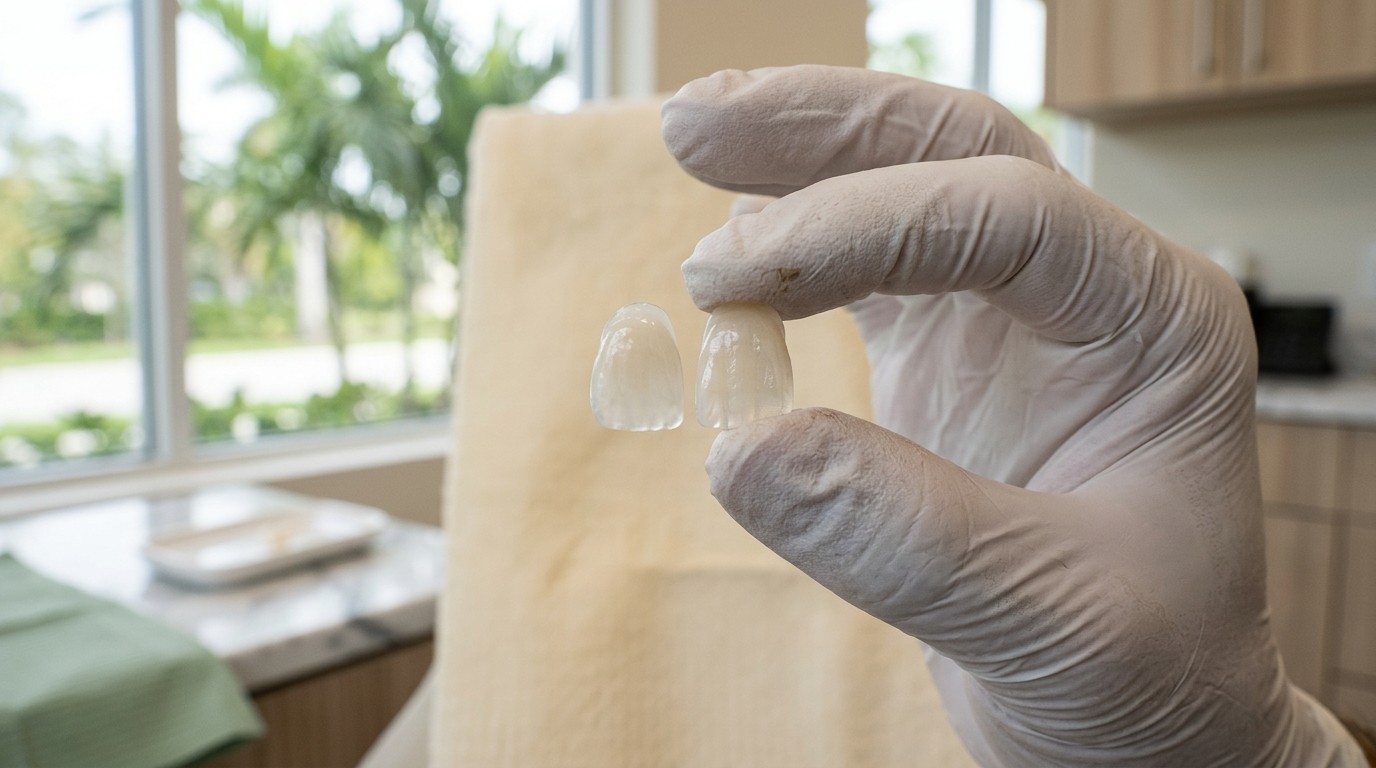
The clearest functional difference is how much tooth structure each option removes. Lumineers are about 0.2 to 0.3 mm thick, roughly the width of a contact lens, and are bonded over the existing enamel with little or no reduction. Traditional porcelain veneers are typically 0.5 to 0.7 mm and call for light reshaping of the front of the tooth so the final result does not look bulky at the gumline. Because Lumineers usually preserve enamel, they are considered reversible in many cases, while conventional veneers are an irreversible restoration. A 9-year prospective comparative analysis on PubMed Central found that minimally invasive no-prep veneers achieved a mean survival time of 10.28 years versus 9.32 years for conventional veneers, which pushes back on the older idea that thinner always means weaker.
Why Enamel Bonding Matters More Than Brand
Both products live or die on the quality of the enamel they bond to. Porcelain bonded to enamel forms a far stronger seal than porcelain bonded to dentin, which is why aggressive prep is a red flag. If a treatment plan calls for grinding teeth into stubs to place "veneers," that is closer to a dental crown than a veneer and the longevity numbers above no longer apply. Dr. Almanzar's preference is the most conservative restoration that still hits your goal, which often means Lumineers or thin custom veneers for color and shape changes, and traditional veneers when teeth are worn short, chipped, or rotated.
Durability, Longevity, and Long-Term Maintenance
Longevity is where patients usually expect Lumineers to lose, but the published data is closer than the internet suggests. The same systematic review of 25 studies covering 6,500 porcelain laminate veneers reported a 10-year survival of 95.5% overall, with fracture and debonding as the most common failure modes. Lumineers, when bonded to healthy enamel by an experienced clinician, can perform in a similar range. Both restorations are sensitive to bite forces, grinding, and margin breakdown, so a custom nightguard, professional cleanings every six months, and avoiding chewing ice or pens are the maintenance fundamentals that actually move the needle.
Cost, Candidacy, and How to Decide
In Florida, premium porcelain veneers commonly run roughly $1,500 to $2,500+ per tooth, and Lumineers sit in a similar premium range because they are still custom-made porcelain restorations. Cost should not be the deciding factor on its own. Lumineers are usually the better fit for patients with reasonably aligned, lighter-shaded teeth who want to brighten and smooth their smile without removing enamel. Traditional veneers are typically a better fit for patients with darker stains, larger gaps, worn edges, or moderate crowding where additive porcelain alone would look bulky. If you are weighing a broader transformation, our smile makeover process guide walks through how Dr. Almanzar sequences whitening, veneers, and bite refinement. For more on permanence, see are veneers permanent, and for a related comparison, see dental bonding vs veneers.

When Lumineers Are Not the Right Call
Lumineers struggle in three scenarios: very dark underlying tooth color that thin porcelain cannot fully mask, significantly worn or chipped teeth that need added length and bulk, and bite issues where the patient grinds heavily. In those cases, traditional veneers, or sometimes a mix of veneers and crowns or bridges for structurally compromised teeth, deliver a more predictable outcome. Honest candidacy is the most important conversation in cosmetic dentistry, and it is where most regret originates.
It is also worth checking comparison details in our deeper guides on veneers vs crowns and porcelain veneers cost in Florida before you decide. The right plan is usually obvious once you see your teeth in a digital smile preview and trial mock-up, which we do in-office before any porcelain is fabricated.
Get a Real Lumineers vs Veneers Recommendation
Ready to find out which option actually fits your smile? Serving Palm Beach Gardens, Jupiter, and North Palm Beach, schedule a comprehensive cosmetic consultation with Dr. Hans Almanzar at Gardens Implant & Cosmetic Dentistry. We will examine your enamel, bite, and color goals, show you a digital preview of both Lumineers and traditional veneer outcomes, and give you a transparent plan with itemized cost. Call (561) 691-1629 or book your free consultation today.
Blog


