Are You Awake During Dental Implant Surgery? Sedation Options Explained
Are you awake during dental implant surgery? Usually yes, but you have four sedation options that range from fully alert to remembering nothing. Here's how to choose.
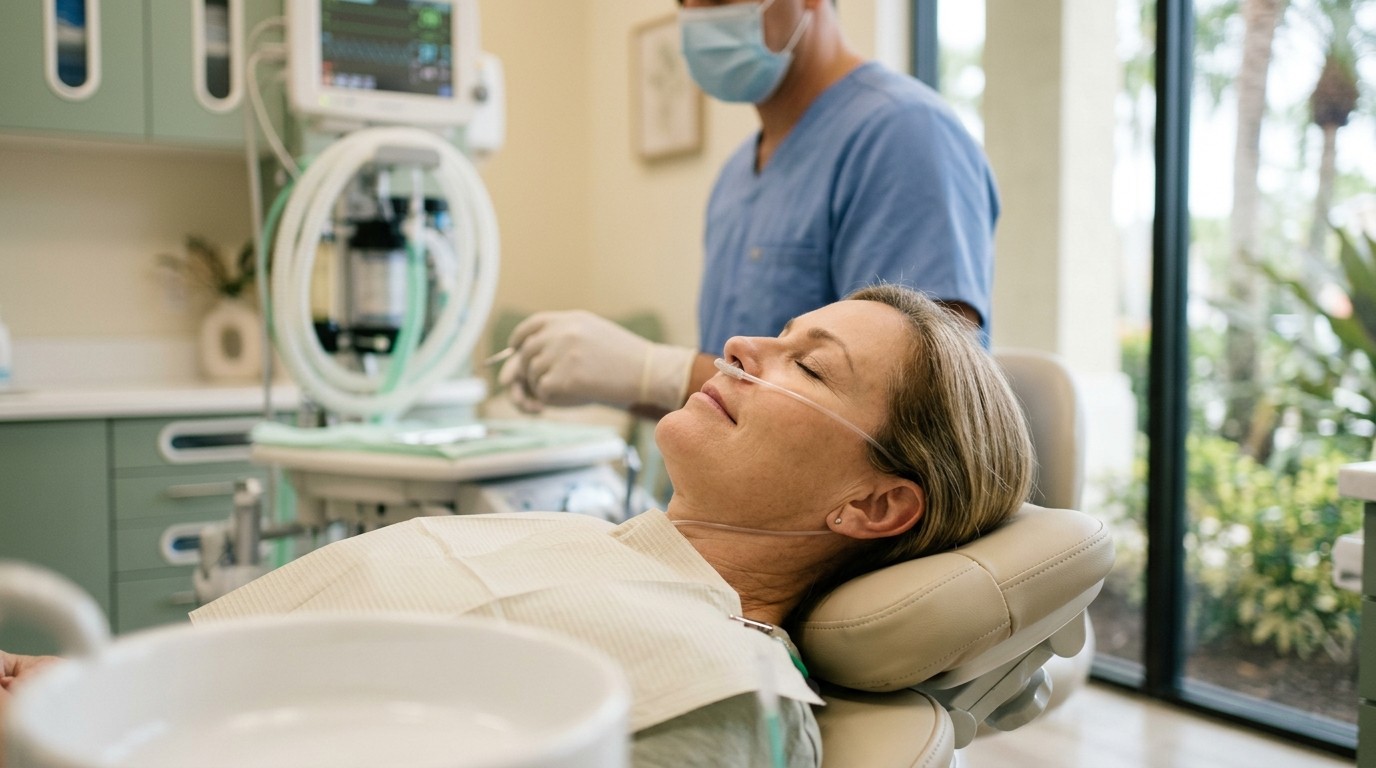
You're Usually Awake, But You Don't Have to Feel It
In most dental implant surgeries, you're technically awake, but "awake" covers a wide range, from fully alert with just a numbed mouth to deeply relaxed with no memory of the procedure. The right answer for you depends on how anxious you are, how many implants are being placed, and your medical history. The American Dental Association released updated sedation and anesthesia guidelines in April 2026 emphasizing patient safety and individualized sedation planning (ADA News, April 2026). Here are the four real options and how to pick.
The Four Sedation Levels for Dental Implant Surgery
TLDR – Implant Sedation Options:
Local anesthesia only: Fully awake, mouth numb, you'll feel pressure but no pain. Most common for one or two implants.
Nitrous oxide (laughing gas): Awake but relaxed, mild euphoria, wears off in minutes. Good for mild anxiety.
Oral conscious sedation: A pill an hour before surgery. Awake but deeply relaxed; many patients have little or no memory afterward.
IV sedation: Medication through a vein. Drowsy, drift in and out of light sleep, no memory of the procedure.
General anesthesia: Fully unconscious. Rare for implants; typically reserved for complex full-arch cases.
Pain during surgery: None at any sedation level. Local anesthetic is always used.
For a single implant or a small case, local anesthesia is usually all you need. The implant procedure itself involves pressure and vibration, not pain, because bone has very few nerve endings. Most patients describe single-implant placement as easier than a tooth extraction and similar to having a filling done. If you're nervous about the sound of the surgical drill or simply don't want to be aware of the procedure, that's where the next levels of sedation come in.
Nitrous oxide is the lightest sedation step beyond local anesthetic. It's delivered through a small mask over your nose, kicks in within minutes, produces a relaxed and slightly euphoric state, and clears your system within five to ten minutes after the gas is turned off. You can drive yourself home, you'll be fully aware during surgery, and your anxiety will be substantially lower than without it. It's a good fit for patients with mild dental anxiety who want to stay alert.

When to Choose Oral Conscious Sedation Versus IV Sedation
If you have moderate to significant dental anxiety, the question becomes oral versus IV sedation. Oral conscious sedation involves taking a prescribed medication (typically a benzodiazepine like triazolam or diazepam) about an hour before your appointment. You'll arrive deeply relaxed and drowsy. You'll respond to verbal cues during the surgery, but most patients have little to no memory of it afterward. You will need a ride home and someone with you for the rest of the day. The advantage is that it's noninvasive and easier to administer than IV sedation. The trade-off is that you can't titrate the dose during the procedure, so the depth of sedation is whatever the pill produces.
IV Sedation: The Most Adjustable Option
IV sedation is administered through a vein and offers the deepest level of relaxation short of general anesthesia. You may be awake, semi-awake, or drift into light sleep, but you won't be fully unconscious. The advantage is that the anesthesia provider can adjust the dose in real time based on how you're responding, so the depth of sedation matches what you actually need at any moment. Most patients have no memory of the procedure afterward, and the experience is described as a long blink. IV sedation requires fasting for six to eight hours before surgery and a driver to take you home. It's the right choice for patients with significant dental anxiety, complex procedures involving multiple implants, or anyone who's had bad experiences with dental work in the past.
When General Anesthesia Is Used (and Why It's Rare)
General anesthesia, where you're fully unconscious and intubated, is rarely used for dental implants. It's typically reserved for full-arch cases like same-day implants or full mouth reconstruction with extensive grafting, patients with severe medical conditions that complicate sedation, or patients with extreme dental phobia who can't tolerate any awareness of the procedure. General anesthesia adds cost, requires a fully equipped surgical suite, and carries the same medical risks as any general anesthesia in a hospital setting. For most single or short-span implant cases, IV sedation provides the same anxiety relief without the additional risk. We'll discuss whether general is appropriate for your case during consultation.

What Sedation Looks Like the Day of Your Implant Surgery
Whatever level of sedation you choose, the local anesthetic that numbs the surgical site is always used. You will not feel pain during the procedure regardless of whether you're alert or asleep. After surgery, sedation effects wear off over a few hours (nitrous in minutes, oral and IV in four to six hours), but you should plan to rest for the remainder of the day. Have someone drive you home, eat soft food, take any prescribed pain medication, and skip work and driving until the next day. Most patients are surprised at how minor the post-operative discomfort is; the anticipation is almost always worse than the experience.
Choose the Sedation Level That's Right for You
Worried about being awake during dental implant surgery? You don't have to be. Our team at Gardens Implant & Cosmetic Dentistry, serving Palm Beach Gardens, Jupiter, and North Palm Beach, offers all four sedation levels and we'll help you pick the one that matches your anxiety level, medical history, and procedure complexity. Schedule a consultation to discuss your sedation options before your implant surgery. Call (561) 691-1629 or book your free consultation.
Blog